 By Zer0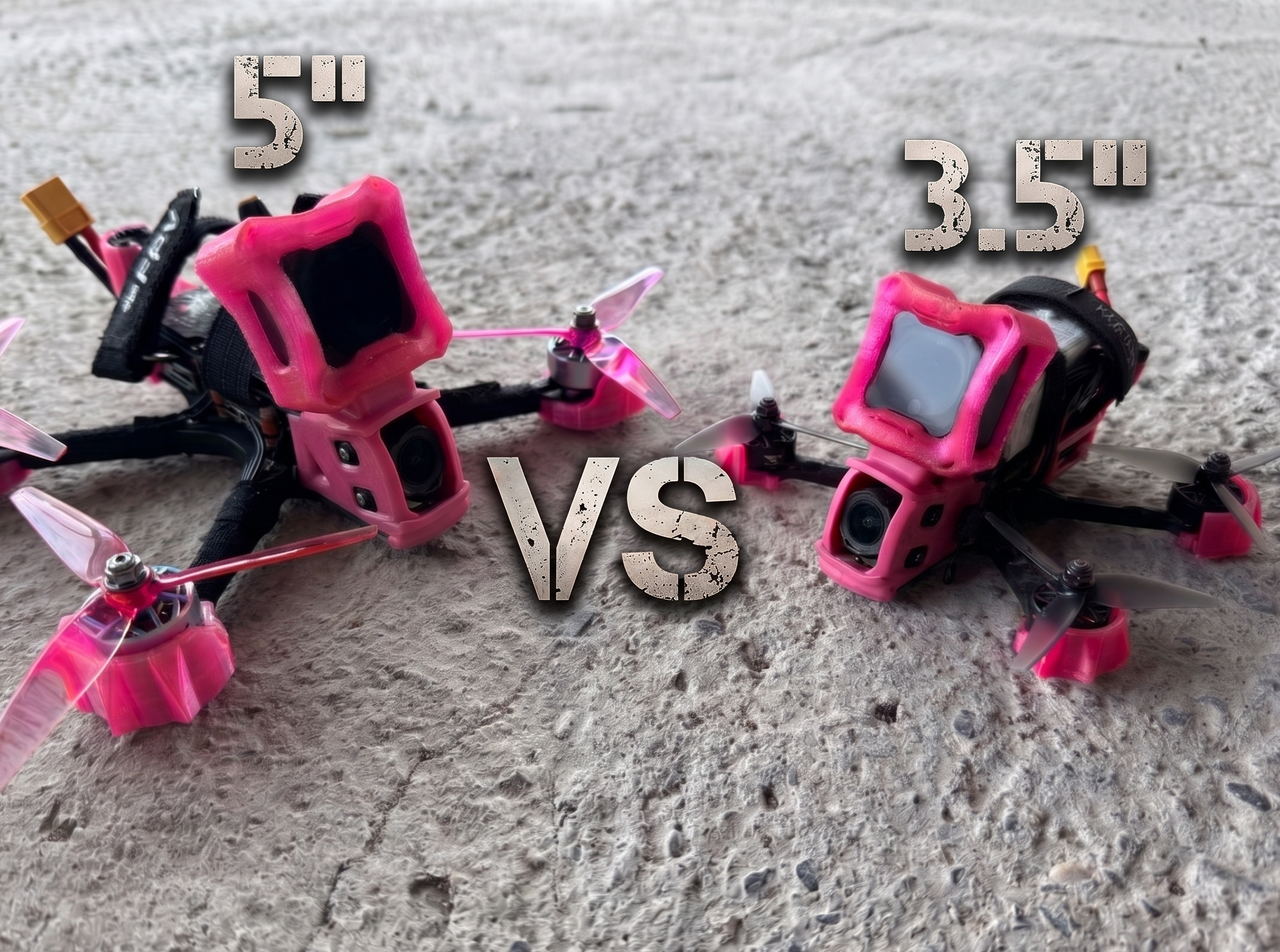
At first, a 3.5 inch drone sounds like it should just be a smaller version of a 5 inch.
That’s what I thought too.
But once you actually spend time flying both, you realize they almost feel like different categories entirely. The size difference sounds small on paper, but in the air they behave very differently. Not just in speed or power, but in the way they carry momentum, recover from mistakes, sound, crash, and even the way they make you approach a spot.
Some people swear by 5 inch and never look back. Others slowly stop flying their bigger builds after getting into 3.5 inch freestyle. And after flying both for a while, I kind of understand both sides.
Weight Changes Everything
One of the biggest differences is simply weight.
A typical 5 inch freestyle build with battery and action camera can easily push well beyond 700 grams depending on the setup. A 3.5 inch build is usually much lighter, often nearly half the weight.
You feel that immediately in the air.
A 5 inch carries itself with a lot more momentum. Once it starts moving, it wants to keep moving. Dives feel larger, turns stretch wider, and tricks feel heavier in a satisfying way.
A 3.5 inch feels much more reactive. It changes direction quickly and recovers faster from awkward movements. You can throw it around more aggressively without constantly feeling like you’re carrying a brick through the air.
That difference also changes your confidence level while flying tight spots.
With a 3.5 inch, I find myself attempting gaps and lines I’d probably hesitate to try with a heavier 5 inch.
Flight Feel
This part is hard to explain unless you’ve flown both.
A 5 inch feels smoother naturally. The extra weight and prop size help it carry motion through lines in a really satisfying way. Big dives and long sweeping movements look cinematic almost without trying too hard.
It also feels more serious in the air. More locked in. More committed.
A 3.5 inch feels more playful.
You can snap it around quickly, make tiny corrections instantly, and recover from weird angles much easier. Flying one almost feels less mentally exhausting because you’re not constantly managing as much momentum.
That’s probably why smaller drones became so popular for tighter freestyle and bando flying. They feel much more comfortable in confined spaces.
Noise Is a Bigger Deal Than People Think
5 inch drones are loud.
Not just “a little noisy.” They sound aggressive, especially on high-pitch props and powerful motors. The deeper sound carries pretty far too.
A 3.5 inch is still loud compared to a regular camera drone, but it feels less overwhelming. The pitch is softer and people nearby usually react less dramatically.
This actually changes where you feel comfortable flying.
There are spots where pulling out a screaming 5 inch immediately attracts attention, while a smaller build feels way less intrusive.
Crashing Feels Different Too
A crashing 5 inch feels violent.
You hear it, you feel it, and sometimes you already know your wallet is about to suffer before you even walk over to pick it up.
Because of the extra mass, crashes usually hit much harder. Props explode more dramatically, arms take heavier impacts, and action cameras definitely don’t enjoy it.
A 3.5 inch still crashes hard of course, but the lower weight helps a lot. You tend to get away with mistakes more often.
That also changes how willing you are to experiment.
I noticed I try riskier lines and sketchier tricks more confidently on smaller builds because crashes just feel less punishing overall.
Carrying Action Cameras
This is still one of the strongest advantages of a 5 inch.
A properly tuned 5 inch can carry a GoPro or DJI Action camera without feeling completely ruined by the extra weight. You still keep decent power and stability.
Smaller drones can carry action cameras too now, especially lighter ones, but you definitely feel the difference more. The drone loses some of that light, playful feeling that makes 3.5 inch builds so fun in the first place.
That’s why a lot of people run naked GoPros or lightweight cameras on smaller freestyle drones.
Wind Handling
5 inch builds definitely handle wind better.
The extra power and weight help keep the drone planted when conditions get rough. Open environments like mountains, cliffs, beaches, or giant abandoned structures feel much more comfortable on a larger build.
A 3.5 inch can still handle wind surprisingly well, but you work harder for it. Gusts move it around more easily and you spend more time correcting the drone.
So Which One Is Better?
I don’t really think one replaces the other.
A 5 inch gives you power, smoothness, and that classic freestyle feeling most people associate with FPV.
A 3.5 inch gives you freedom. You can fly tighter spots, take more risks, carry less stress, and honestly just have fun in a different way.
Some days I want the heavy, aggressive feel of a 5 inch ripping through a huge abandoned building.
Other days I just want to throw a small drone through tight concrete gaps without sounding like I’m starting a chainsaw in the middle of the city.
That’s probably why so many FPV pilots eventually end up owning both.