 By Zer0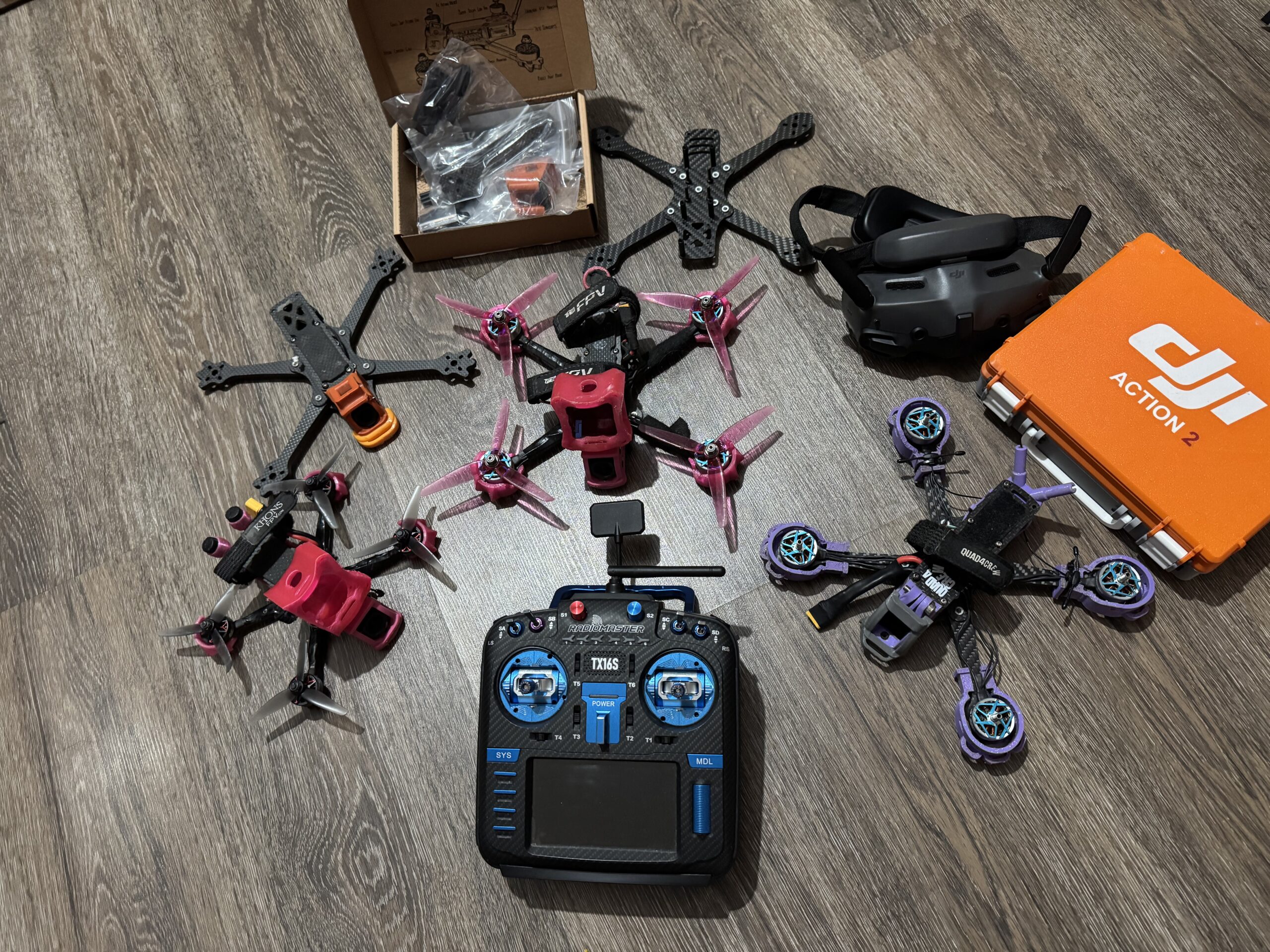
FPV is one of those hobbies where the first price you see is almost never the real price.
At first, you think you’re buying a drone.
Then you realize you also need goggles, a radio, batteries, a charger, props, tools, spare parts, storage, bags, screws, straps, antennas, soldering equipment, and the emotional strength to watch your expensive flying brick hit concrete at full speed.
So yes, FPV is expensive.
But the annoying answer is: it depends how deep you go.
The Drone Is Only One Part of the Cost
When people ask how much FPV costs, they usually think about the quad itself.
But the drone is just one piece of the setup.
For example, my current 5 inch build is based around:
- FPV ERA 5 frame for DJI O4
- DJI O4 Air Unit Pro
- Rush Blade Digital F722 flight controller
- Rush Blade Extreme 60A ESC
- T-Motor Pacer V3 Freestyle 1950KV 2207 motors
- Ethix P3.5 Rad Berry props
- Tattu R-Line V6 1480mAh 160C 6S batteries
- ToolkitRC M6D Dual smart charger
- Action Cam: DJI Action 2
That already sounds like a shopping list written by someone who lost control of their life.
And that is before adding the goggles and radio.
The DJI O4 Air Unit Pro alone is listed by DJI at $229, while DJI Goggles 3 are listed at 659 euros on DJI’s store. RadioMaster’s TX16S Mark II Max starts from $249.99 depending on version.
So even before the drone is fully built, the “I just want to try FPV” phase can become very serious very quickly.
Here is a not-so-complete list of my gear for a 5″ drone:
| Part | Approximate Price |
|---|---|
| DJI O4 Air Unit Pro | ~$229 |
| DJI Goggles 3 | ~$719 |
| RadioMaster TX16S MK2 Max | ~$250 |
| It’s FPV Era 5 for O4 frame | ~$90 |
| Rush Blade Digital F722 FC | ~$80 |
| Rush Blade Extreme 60A ESC | ~$90 |
| T-Motor Pacer V3 1950KV 2207 Motors (x4) | ~$100 |
| Ethix P3.5 Rad Props | ~$4 |
| Tattu R-Line V6 1480mAh 160C 6S Batteries (x4) | ~$180 |
| ToolkitRC M6D Dual Smart Charger | ~$110 |
| DJI Action 2 | ~$250 |
| TOTAL | ~$2,102 |
And honestly, that total still ignores:
- soldering tools
- LiPo bags
- spare props
- replacement motors
- backpack/carry case
- field charging gear
- storage drives for footage
- random FPV purchases at 2 AM that somehow feel justified
The scary part is that none of this even feels excessive by FPV standards.
There are pilots casually carrying backpacks worth more than used cars.
Goggles and Radio Hurt the Most at First
The painful part about starting FPV is that some of the most expensive items are things that don’t even fly.
Goggles are probably the biggest shock. With digital FPV systems like DJI O4, the image quality is amazing, but the entry cost is not exactly friendly.
Then comes the radio.
I use the RadioMaster TX16S MK2 Max, which is definitely not the cheapest option. It feels premium, has a big screen, lots of switches, and it is probably more radio than I need as a beginner-intermediate pilot.
But I also like that it is something I can grow into.
That is kind of the trap with FPV. You keep saying “I’ll buy the better one now so I don’t have to upgrade later.”
Sometimes that makes sense.
Sometimes it is just cope with extra steps.
Batteries Are Consumables
Nobody warns you enough about batteries.
You don’t buy one battery. That would be pointless.
You buy several, because each pack only gives you a few minutes of flight depending on how aggressively you fly. My 5 inch uses Tattu R-Line V6 1480mAh 160C 6S packs, and each one weighs around 220 grams according to Tattu’s specs.
That means every flying session depends on how many packs you bring.
More batteries means more flight time.
More flight time means more charging.
More charging means you probably need a better charger.
Then maybe a field charging setup.
Then maybe more batteries again.
It slowly becomes a circle.
Not a healthy circle, but a circle.
Props Are Cheap Until They Aren’t
Props are one of the cheapest parts of an FPV drone, which tricks you into not thinking about them.
I use Ethix P3.5 Rad props, and like most freestyle props, they are basically consumables.
You hit a branch, change a prop.
Clip concrete, change a prop.
Land badly, maybe change a prop.
Look at the drone wrong, somehow also change a prop.
One set is not expensive, but over time props become one of those background costs that never really disappears.
It is like buying guitar picks, except the guitar sometimes punches a wall.
Crashes Are Part of the Budget
This is where FPV becomes different from many other hobbies.
Crashing is not an accident in FPV.
Crashing is part of the learning process.
Especially if you fly freestyle, bandos, tight gaps, or anything close to objects, damage is not a question of “if.” It is “when” and “how annoying will it be this time?”
With a 5 inch build, crashes can mean:
- broken arms
- bent motor shafts
- damaged motor bells
- cracked camera mounts
- destroyed props
- damaged batteries
- loose solder joints
- random problems that make you question your sanity
The FPV ERA 5 frame should take a decent amount of abuse, but no frame makes crashes free.
Every time you try a risky line, there is a tiny accountant in your brain whispering: “Are we financially sure about this?”
Tools Are Another Sneaky Cost
Another thing beginners underestimate is tools.
You eventually need things like:
- soldering iron
- solder
- flux
- hex drivers
- smoke stopper
- battery checker
- LiPo safe bag or ammo box
- spare screws
- zip ties
- heat shrink
- double-sided tape
- spare straps
None of these sound dramatic individually.
But together they become the “why did my small hobby order turn into a full electronics bench?” moment.
FPV is not just flying. It is flying, repairing, troubleshooting, swearing quietly, then flying again.
Digital FPV Makes It Even More Expensive
Analog FPV can still be cheaper, and many pilots still love it.
But once you go digital, especially with DJI O4, the cost goes up quickly.
The upside is obvious. The image in the goggles is clean, detailed, and much easier to fly confidently compared to old-school analog static.
The downside is that replacing digital video parts hurts more.
A broken prop is annoying.
A broken air unit is a small tragedy.
That is one reason I sometimes understand people who still fly cheaper setups for risky spots. When you are diving concrete or flying abandoned buildings, expensive gear makes your hands just a little sweatier.
So How Expensive Is FPV Really?
If you want the honest answer, FPV can be “manageable expensive” or “what have I done expensive.”
A simple beginner setup can be kept somewhat reasonable if you buy carefully, start small, and avoid chasing the newest gear immediately.
But a full digital 5 inch freestyle setup with DJI O4, Goggles 3, a proper radio, quality batteries, strong electronics, good motors, tools, and spares can easily become a serious investment.
And the funny part is, once you have the setup, the spending does not fully stop.
You will still buy props.
You will still buy batteries.
You will still break parts.
You will still convince yourself that one more frame makes sense because this one is “for a different style of flying.”
That is FPV.
It is expensive, technical, frustrating, addictive, and somehow still worth it.
Because the first time you rip through a gap, dive a building, or fly a line exactly the way you imagined it, your brain immediately forgets the cost.
At least until the next crash.